Portland Women's March Wrestles With Issues Of Race, Feminism And Leadership
by Shasta Kearns Moore
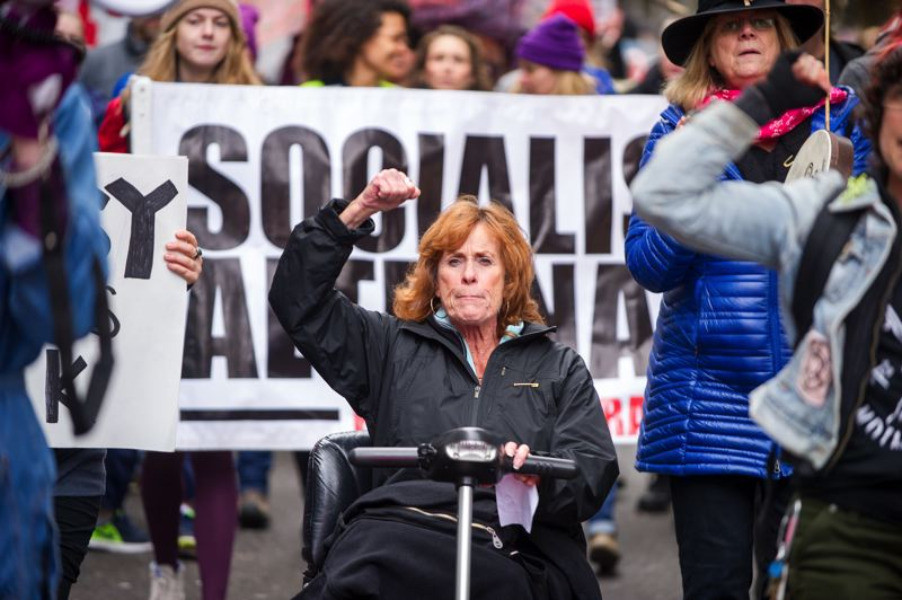
If Saturday’s Women’s March on Portland draws the expected 30,000 or more participants, it could be the biggest demonstration the city has ever seen.
And it almost didn’t happen.
The real story behind the march isn’t completely known even to its lead organizer, but in many ways, it is a familiar one.
The march is a reaction to the election of Donald Trump, and nearly all of the forces at work to upset politics in the 2016 presidential race were also in play in organizing the Portland march: social media, race, gender, the urban-rural divide, generational concepts of feminism and, most of all, lots of people feeling like they weren’t being heard.
Read more atThe Portland Tribune
Citizen Advisory Groups React To Trump Administration Suspension
by Amanda Peacher | May 15th, 2017
President Donald Trump’s administration has signaled it wants local residents to have more say in decisions about public lands in their backyard.
But earlier this month the Interior Department canceled upcoming meetings of local citizen groups that give input to the Bureau of Land Management on how to manage public lands.
Most people have never heard of these groups because much of their work is done behind the scenes. They’re called Regional Advisory Councils — or RACS.
The volunteer groups meet a few times a year to discuss how the BLM manages public lands, and they then make recommendations to the agency about best practices. They provide input on everything from how to deal with invasive weeds on rangeland to how to manage overpopulated wild horses to how much the BLM should charge rafters to float Hell’s Canyon.
The RACS are made up of people who are invested in public lands, including ranchers, environmentalists, tribal leaders and county administrators.
“The RACS probably are the best thing that the government has ever done,” said Terry Drever-Gee, who represents mining interests on the John Day-Snake River RAC.
Drever-Gee has been on the RAC since its inception in 1996 and says it’s a vital opportunity for diverse interests to discuss land management.
“I was pretty staunch conservative and ‘everybody is against us,’” said Drever-Gee, who lives in Baker City. “I would sit and listen, and as I would listen, I would go, ‘They want exactly the same thing that we want.’”
For many in rural Oregon, the move is puzzling from an administration that has signaled it wants local residents to have greater say in how public lands are managed.
“It’s definitely a move that’s pretty contrary to this whole rhetoric of increasing accountability and transparency and minimizing government regulation for the benefit of the people,” said Erica Maltz, who represents the Burns Paiute Tribe on the John Day-Snake River RAC. “This is one of few forums where the people get to say —in a formal way — what the people think.”
Dozens of RAC members sent a letter to Zinke last week criticizing the suspension and saying that this is preventing important work from happening over summer.
But other RAC members were less concerned. They said Interior Secretary Ryan Zinke has a right to shake things up.
“It’s not a big deal if there’s a two-month delay. Right now people are waiting to see what’s going to come from Zinke,” said David Schott, president of Forestglen Lumber Co. in Medford and chair of the Southwest Oregon RAC. “I think BLM really strongly supportive of the committee. I think they like the feedback.”
Schott said that he appreciates the cross-section of community members represented in the group. But he also said that his RAC doesn’t have a solid direction: The group has been reactive to concerns brought forth by the BLM rather than proactive about suggesting management direction.
The suspension of these groups means that the upcoming summer meetings are canceled — that’s one of typically four meetings of these groups each year.
“I think the public ought to know that one of their key mechanisms for having relatively direct communication with federal land managers is at risk here. Or at least a question,” said Randy Jones, who works for Oregon’s Department of Environmental Quality and serves as the chair for the John Day-Snake River RAC.
The John-Day Snake River RAC was in the process of making recommendations for boater fee structures on the lower Deschutes and Snake rivers in Hell’s Canyon. Members were also planning to review a recent Forest Service management plan at their May meeting, which had been scheduled for this week. Consequently, the agencies may move forward without the input of the citizen group.
“We’re not going to have the opportunity to engage in the review of those issues,” Jones said. “Effectively the suspension does eliminate representation.”
The six Oregon and three Washington RACs are among 38 similar groups nationwide. Each group has a formal charter, and members are appointed locally and then approved by the Interior Department in Washington D.C.
In a statement, the Interior Department said that the suspension would allow it to review the charters and missions of the groups, “to maximize feedback from these boards and ensure their compliance with the Federal Advisory Committee Act and the President’s recent executive orders.” The department gave no indication whether the RACs might proceed as usual in the fall.
Oregon’s two U.S. senators, Jeff Merkley and Ron Wyden, issued a joint statement Friday lambasting the suspension of the RACs.
“We are very concerned about this news and would like an answer as to why the RAC meetings were postponed during the BLM’s review of all advisory boards and committees,” the two Democrats wrote. “It is critical that local voices, including RACs, have the opportunity to provide input and take part in the process at all times, not just when those local voices align with the Administration or a large special interest.”
U.S. Rep. Greg Walden, R-Ore., was asked about the future of RACs at recent town hall meetings in eastern Oregon. A spokesman for Walden said the congressman understands the important role resource advisory councils play in Oregon’s rural communities, Walden spokesman Justin Discigil said in an email to OPB.
“The Interior Department’s review is set to be complete by September after a one meeting hiatus for the councils,” Discigil wrote. “Greg looks forward to working with Secretary Zinke and his team at the Interior Department to improve the councils, and strengthen local input in federal land management decisions.”
Jim Bishop, who serves on the Southeast Oregon RAC, told OPB his group was disturbed by the suspension.
“We got really mad really fast,” said Bishop, who is a retired hospital administrator in Burns and an at-large member of the RAC. “There really are a wide number of people representing a wide number of interests on that RAC. Even though we may disagree with someone’s ideas, we have a tremendous amount of respect for each other, and the process.”
Jes Burns of EarthFix contributed to this report.
Oregon Fight Over LNG Project Latest NW Action On Fossil Fuels
by Phuong Le | May 14, 2017
Residents of a coastal community in Oregon are considering whether to try to derail a fossil fuel export project in their rural county, a decision that could put them at odds with the Trump administration.
The ballot measure before Coos County voters Tuesday would block the $7.5 billion Jordan Cove Energy Project, a proposed liquefied natural gas port that would be the first of its kind on the U.S. West Coast.
The vote comes weeks after an adviser to President Donald Trump said the administration would approve the project. Federal regulators denied a permit for the export terminal and pipeline under President Barack Obama.
In recent years, American Indian tribes and environmentalists have successfully fought a number of fossil fuel export projects in the Pacific Northwest, and pushed for local regulations to prevent new projects.
As President Trump aggressively pushes fossil fuel exploration, opponents say they’re more focused than ever on actions at the state and local level to stop the Northwest from becoming a gateway for exporting the nation’s fossil fuels.
“We’ve all been waiting nervously for the Trump administration to dial up the intensity,” said Eric de Place with Sightline Institute, a Seattle-based environmental research group.
Since 2010, at least 20 projects have been proposed in Oregon and Washington to handle and move coal, crude oil, methanol, propane or liquefied natural gas, but only a few have come to fruition.
“Almost all the victories happened at the state or local level,” de Place said.
Other examples of local pushback include:
— The city of Portland, Oregon, in December banned new bulk fossil fuel storage terminals within city limits. The ban was considered the first of its kind for the range of products it sought to prohibit. A coalition of business, labor and oil industry groups is appealing it before a state board.
— Whatcom County in northwest Washington this year extended a moratorium on new shipments of refined fossil fuel as it considers other possible land-use code changes.
— Two other cities in Washington — where major crude oil terminals have been proposed — banned new crude oil storage facilities. The Vancouver ban doesn’t apply to a massive proposed oil terminal there that would be the largest in the United States.
Mary Geddry, who helped petition to put the latest ballot measure before Coos County’s 41,000 voters, said opponents needed to try something new.
“We just don’t want to see Coos Bay turned into the toxic armpit of Oregon,” she said. “By creating a bill of rights, then we can defend it by saying that project, that activity violates our fundamental rights.”
The measure would allow the transportation of fossil fuels within the county only if they’re intended for local use. It also would set up a bill of rights outlining the community’s right to a “sustainable energy future.”
Critics say the measure is unconstitutional and taxpayers will be forced to needlessly defend it.
It’s unclear if the measure would hold up in court. Local and state regulations are subject to legal challenge because the federal government’s authority to regulate interstate commerce can supersede rules enacted at a lower level.
The Jordan Cove Energy Project has donated nearly all of the $573,000 raised so far to oppose the measure, campaign records show. Supporters have raised nearly $13,000.
Project spokesman Michael Hinrichs said he’s hopeful the ballot measure will be struck down. Proponents say the project will create jobs and generate millions in tax revenues in rural Oregon.
In March 2016, the Federal Energy Regulatory Commission denied the Jordan Cove LNG project and a 232-mile (373-kilometer) pipeline that would carry natural gas to the Oregon coast.
FERC said demand was lacking, and negative impacts on landowners outweighed the public benefits. The agency also denied the project’s request for a rehearing in December.
But the company refiled, and FERC in February cleared the way for developers to resubmit their application.
Gary Cohn, who directs the White House National Economic Council, said last month that the United States could be and should be the largest exporter of LNG in the world. “The first thing we’re going to do is we’re going to permit an LNG export facility in the Northwest,” he said.
Hinrichs said support from the White House for credible energy projects like Jordan Cove is refreshing and reinforces the owners’ confidence in its project. Earlier this month, Pembina Pipeline Corp. announced it would buy owner Veresen Inc. and said the company “will continue to build upon the momentum” of the Jordan Cove project.
But Brett VandenHeuvel, whose Columbia Riverkeeper group has challenged several fossil fuel projects, said it’s disappointing that a project “that has been rejected multiple times keeps getting new life.”
Across the Northwest, those opposing fossil fuel export projects have staged elaborate protests, packed meeting rooms and successfully sued to block efforts before city administrators and in state courts.
“The fact that none of these large projects have been constructed is really a testament to people standing up to protect what they love,” VandenHeuvel added. “These are very local issues that have huge national and international implications.”